

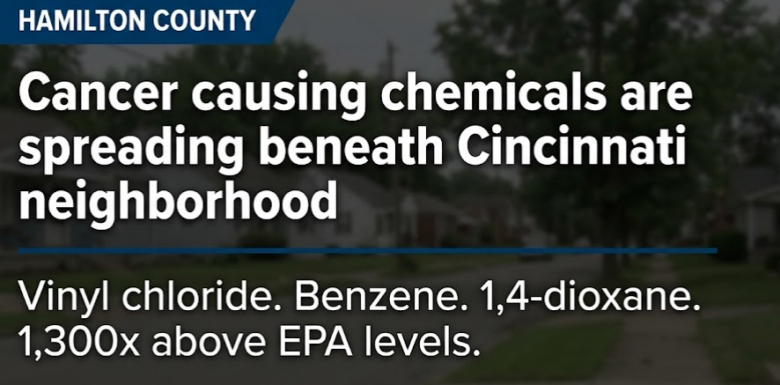
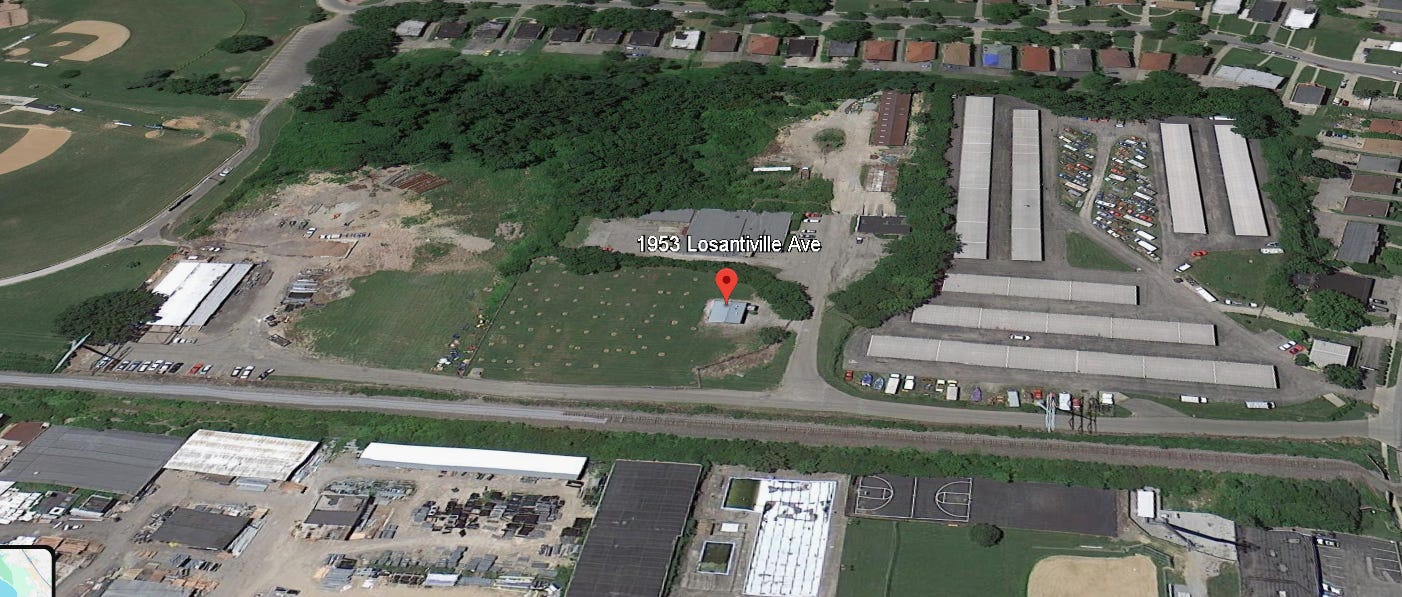
CINCINNATI, Ohio – For well over three decades, the site of a former Ashland chemical distribution facility at 1953 Losantiville Avenue in Cincinnati has been releasing a plume of carcinogenic volatile organic compounds into the groundwater beneath a residential neighborhood and near local parks. The remediation system meant to clean it up was shut down in 2016. The contamination is not just persisting — it is possibly spreading. And Ashland has repeatedly failed to give Ohio EPA the information it needs to determine how far it has gone.
Now, Ohio EPA is ordering the company to test the air inside nearby homes.
Two Ohio EPA documents obtained by the Guardian — a September 2025 Notice of Deficiency letter and a June 2026 approval letter for vapor intrusion sampling — paint a picture of a contamination crisis that has been building for decades while regulators struggle to get a multinational corporation to follow basic cleanup protocols.
What is in the groundwater
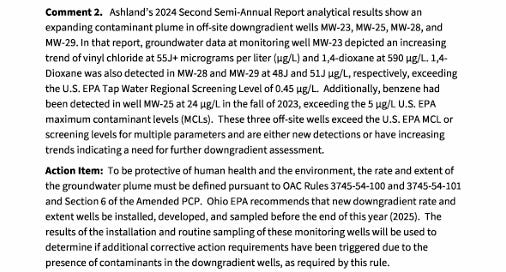
Groundwater monitoring data spanning nearly 30 years documents 16 separate toxic and carcinogenic compounds still present in groundwater at the site at concentrations exceeding regulatory screening levels. The list includes vinyl chloride — a known human carcinogen — at concentrations in off-site monitoring well MW-23 of 55 micrograms per liter, more than 27 times the EPA maximum contaminant level of 2 micrograms per liter. Benzene, another known human carcinogen, was detected in off-site well MW-25 at 24 micrograms per liter — nearly five times the federal drinking water standard of 5 micrograms per liter.
The probable human carcinogen 1,4-dioxane — a contaminant Ohio EPA specifically requested be added to the monitoring program — was detected in off-site well MW-23 at 590 micrograms per liter. The EPA tap water screening level for 1,4-dioxane is 0.45 micrograms per liter. The concentration found at MW-23 is more than 1,300 times the threshold.
Monitoring well MW-19, one of the most heavily contaminated wells on the site, showed total VOC concentrations of 285,179 micrograms per liter in September 2024 — a figure that represents the combined concentration of multiple toxic chemicals in the groundwater at that location.
The contamination is spreading toward homes on Eastlawn Drive
The contamination is not confined to the former Ashland property. Eleven of the 21 monitoring wells in the current program are located on neighboring properties — meaning the plume has already spread beyond the site boundary. Ohio EPA’s September 2025 letter specifically identifies four off-site downgradient wells — MW-23, MW-25, MW-28 and MW-29 — as showing expanding contamination, with new detections and increasing trends indicating the plume is actively moving.
Groundwater flows to the northwest from the site — directly toward Eastlawn Drive, a residential street. Ohio EPA’s letter explicitly requests that Ashland’s site maps be updated to include the residential homes on both sides of Eastlawn Drive and that new monitoring wells be installed along that street to track how far the contamination has spread.
The cleanup stopped nine years ago
The former Ashland Distribution Facility is a vacant property currently for sale. A groundwater recovery and treatment system once operated on—site but was shut down in May 2016 and has never been restarted. For nine years, the contamination has been monitored but not treated while the plume continues to migrate toward the surrounding neighborhood.
Ashland has repeatedly failed to meet Ohio EPA requirements
Ohio EPA’s September 2025 Notice of Deficiency letter documents a pattern of failures by Ashland and its consultants that spans years.
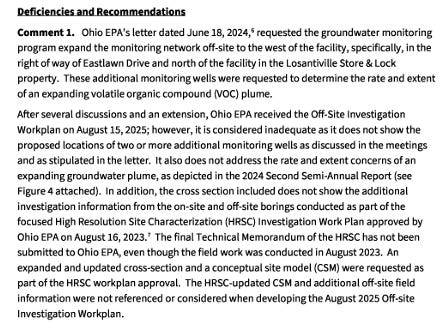
In June 2024, Ohio EPA requested that Ashland expand its monitoring network to include new wells along Eastlawn Drive to track the expanding plume. More than a year later — after multiple meetings and an extension — Ashland submitted a work plan that Ohio EPA found inadequate. It did not show the locations of the requested monitoring wells and did not address the rate and extent of the expanding plume.
A High Resolution Site Characterization investigation was conducted in August 2023. As of September 2025 — two full years later — Ashland had not submitted the final technical memorandum of that investigation to Ohio EPA. Ohio EPA is still waiting for it.
Sampling protocol violations were first identified in an Ohio EPA letter in January 2020. They were still occurring in 2025. Fifteen of the 21 monitoring wells were sampled in violation of approved protocols during the April 2025 sampling event — meaning the data collected may not accurately reflect actual contamination levels.
Quality control improvements were promised by Ashland in writing in May 2022. They were not implemented in subsequent sampling events.
Ohio EPA issued a formal Notice of Violation on September 11, 2025 — a separate enforcement action documenting violations identified during its review of Ashland’s monitoring reports.
Ohio EPA orders testing inside homes
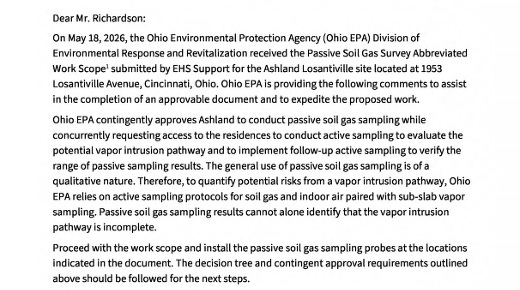
On June 9, 2026, Ohio EPA issued a letter to Ashland’s remediation project manager ordering the company to conduct passive soil gas sampling while simultaneously seeking access to nearby residences to conduct active indoor air sampling. The purpose is to determine whether volatile organic compounds from the contaminated groundwater are migrating upward through the soil and entering the homes of people who live near the site — a process known as vapor intrusion.
“Passive soil gas sampling results cannot alone identify that the vapor intrusion pathway is incomplete,” Ohio EPA wrote.
Vinyl chloride, benzene and the other carcinogens documented in the groundwater at this site are volatile — they evaporate from contaminated soil and groundwater and can migrate upward as invisible gases into buildings through foundations, floors and walls. People exposed to these vapors inside their homes would have no way of knowing it without testing.
Ohio EPA’s order to test inside homes signals that the agency believes the risk to nearby residents is real enough to require direct measurement of indoor air quality — not just continued monitoring of what is in the ground.