

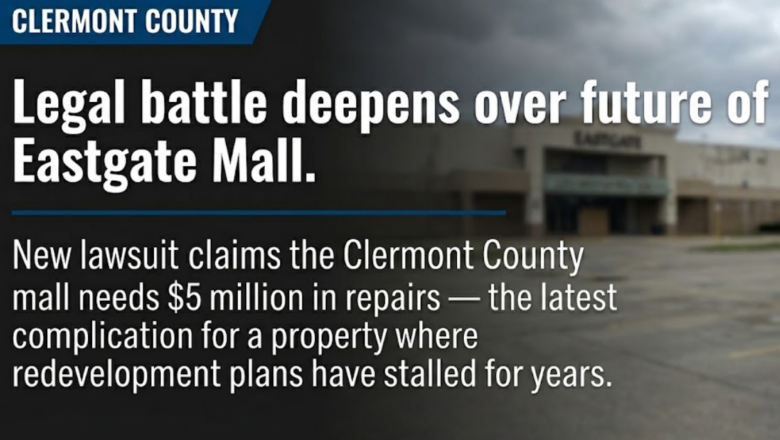
CLERMONT COUNTY, Ohio — The future of Eastgate Mall is facing another legal setback after a new lawsuit claimed the Clermont County property needs millions of dollars in repairs.
The case is the latest complication for one of the county’s best-known retail sites, where redevelopment hopes have already been slowed by court disputes and competing plans for the property.
Eastgate Mall opened in 1980 and was once a major shopping destination for Clermont County and the wider east side of Cincinnati. Today, the mall remains open, but large parts of the property have been affected by empty storefronts, ageing infrastructure and uncertainty over what comes next.
The latest lawsuit was brought by RCC Eastgate Mall LLC, which owns an outparcel on the east side of the mall, against Hull Property Group, the Augusta, Georgia-based company that owns the mall’s main building. The case was filed in Clermont County Common Pleas Court.
The lawsuit claims the mall property has been allowed to deteriorate and alleges problems including exterior lighting, building façades, parking areas and the roof. Reports on the case put the alleged repair costs at about $5 million.
According to the lawsuit, RCC claims Hull is required under an older operating agreement to keep parts of the property and surrounding areas in good order and repair. The complaint is asking the court to require repairs and future maintenance at the site. Hull Property Group has not publicly responded to the latest claims in the reports reviewed by Clermont Guardian.
The dispute comes as the future of the wider Eastgate Mall property remains unresolved. A separate legal battle has already affected plans involving the former Sears site, where Kroger has been linked to plans for a new Kroger Marketplace. Union Township has previously discussed a wider vision for the roughly 100-acre mall property, including housing, offices, shopping, restaurants and entertainment.
But redevelopment is complicated by the mall’s ownership structure. Multiple property owners have rights connected to the site, making it harder for one owner to move ahead without agreement from others.
No final ruling has been made on the latest lawsuit.
Why are old malls so hard to redevelop?
Large malls often have complicated ownership structures. One company may own the main mall building, while others own former department stores, outparcels, parking areas or nearby buildings. That means redevelopment can involve several different owners, legal agreements and veto rights over what can be built or changed. At Eastgate Mall, the court fights show why turning an ageing mall into housing, restaurants, entertainment or new retail can take years — even when local residents and businesses want to see the area revived.